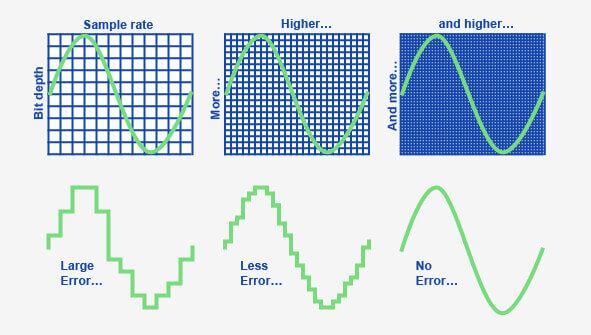
Source: RouteNote
Sound
Soundwaves are fluctuations of the pressure of a medium, such as air. The height of this fluctuation is called amplitude and corresponds to the loudness of a sound (measured in decibel, ). The number of full up-and-down movements of pressure in a unit of time is called its frequency, which we perceive as the pitch (measured in ), i.e. how high or low a sound is. Using microphones pressure fluctuations in, say, air can be turned into an electrical signal, which correspond to continuous fluctuations of voltage over time.
Analog vs. Digital Signals
When we want to turn these continuous analog signals into something that a computer can work with more easily we convert them into digital signals that can be represented as zeroes and ones. To do this, we need to slice up a continuous signal (think of a smooth wave) into little chunks and measure the amplitude (height of the wave).
Sampling Rate
The number of slices per unit time is called the sampling rate (expressed in ). The higher the sampling rate, the more slices per unit time, and the closer the resemblance of a digital approximation to the actual analog signal.
Bit Depth
The second key factor that affects the quality of resemblance between the digital representation and the analog signal is the bit depth, which is the number bits used to represent changes in amplitude. The higher the bit depth the more steps are used to mimic a smooth change in amplitude.
A Useful Analogy
In short, this analogy might help: Imagine you’re painting a picture, but you’re only given a set number of colours and are only allowed to use a defined number of strokes. The selection of colours corresponds to the bit depth, while the number of strokes corresponds to the sampling rate
The .wav - Format
Having turned an analog signal into a digital one using appropriate sampling rate and bit depth, we have what we could call digital audio, which is commonly stored using the .wav format (pronounced wave). This is a binary format, meaning that if you were to open the file in a text editor, you would find little that you would recognise, but computers can work with binary formats very efficiently. As opposed to .mp3, .wav is uncompressed, meaning we didn’t use any mathematical tricks to reduce the file size.
Problems with Compression
When analysing audio, working with uncompressed audio is very important, as compression can lead to artefacts - the appearance of effects that result only from our manipulation of the data (e.g. the compression) and aren’t really present in the raw data.